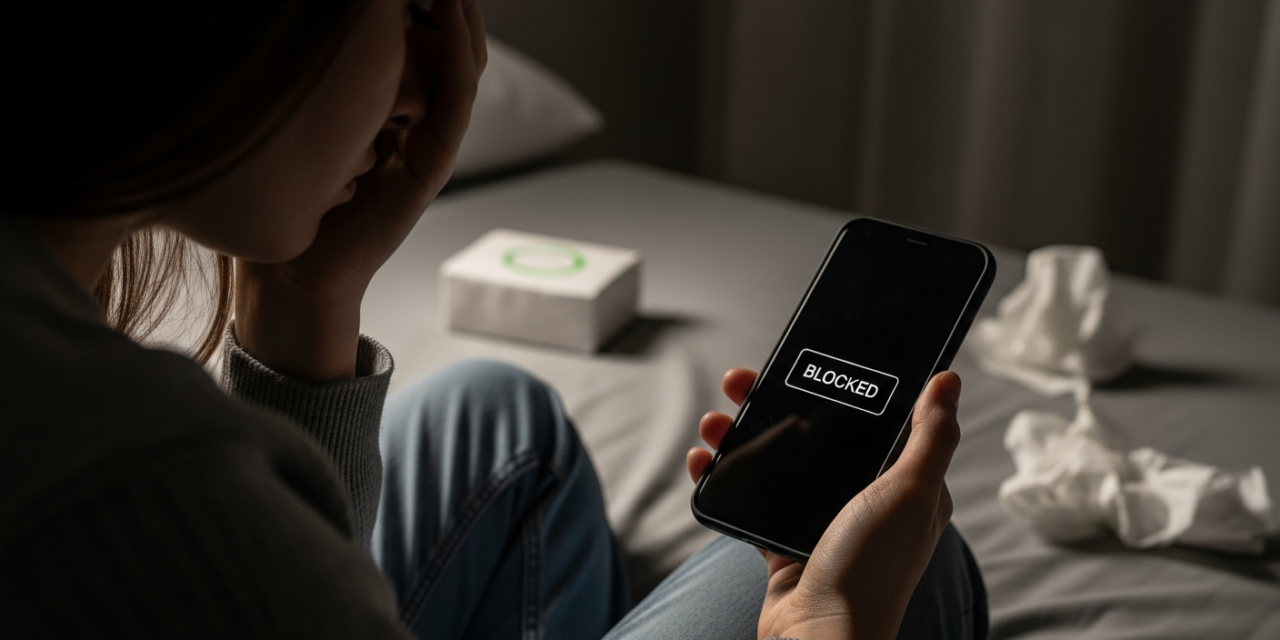
If he’s blocked you, it can feel like someone slammed a door in your face mid-sentence.
One minute you’re trying to explain, apologise, or just get a scrap of clarity… and the next you can’t see his profile, your messages won’t go through, and your mind starts doing that awful thing where it fills the silence with worst-case stories.
So let me start here, gently but clearly: being blocked doesn’t automatically mean it’s over forever.
It usually means right now he feels overwhelmed, flooded, angry, hurt, or tired of the cycle—and he’s chosen the fastest boundary available.
And that matters, because the way you respond to being blocked can either quietly rebuild your credibility… or confirm his fear that contact with you equals pressure.
This is your guide to doing the first one.
Why Men Block (And Why It’s Not Always Cruel)
When women come to me and say, “He blocked me—why would he do that?” they usually mean, “How can someone who cared about me shut me out like that?”
Here are the most common reasons, in plain human terms:
Sometimes he blocks because he’s trying to stop himself from being pulled back in. He might still have feelings, but he doesn’t trust his own self-control—or he doesn’t trust that the relationship won’t spiral again. Blocking becomes his “emergency brake.”
Sometimes he blocks because he feels emotionally flooded. If arguments escalated, or there were long text chains, emotional messages, repeated contact, or a breakup that turned messy, he may be trying to protect his nervous system. It’s not romantic, but it’s real: some people cope by shutting down communication.
Sometimes he blocks because he’s trying to regain control. If he felt powerless in the relationship—or in the breakup—blocking can be a way to feel in charge again.
And yes, sometimes he blocks because he’s done and doesn’t want to be persuaded. That’s painful, but it’s also reality.
The key is this: blocking is a boundary. Your best chance of ever being unblocked starts with proving you can respect boundaries, even when you’re hurting.
The Biggest Mistake After You’ve Been Blocked
The most common reaction is panic-contacting.
You text from a different number. You message on a different platform. You ask mutual friends to “just tell him…” You send a long email. You comment on something. You create new accounts.
I understand the impulse. When you’re distressed, your brain goes into attachment alarm mode. You’re not thinking, “What’s the smartest strategy?” You’re thinking, “I need relief, I need connection, I need certainty.”
But here’s the hard truth: going around a block usually turns a temporary boundary into a permanent one.
Because to him it feels like:
“I said no contact, and she ignored it. This is why I blocked her.”
So if you want a real shot at reconciliation, you start by doing the bravest, most powerful thing:
You stop chasing.
Not as a punishment. Not as a tactic. As a reset.
Step One: Regulate Yourself Before You Do Anything Else
I know you want steps like “send this message” or “do this clever thing.”
But the truth is, when you’re emotionally activated, you will almost always send something you regret. You’ll come off intense, pleading, angry, sarcastic, or “too much.” Even if your intention is love, your tone will be fear.
So before we talk about getting your ex back after being blocked, we talk about steadying your nervous system, because calm is attractive—and panic is contagious.
Try this for 72 hours:
-
No checking his socials (even through friends).
-
No “drafting messages” to get it out of your system (it keeps you hooked).
-
Write in a private note: What would I need to feel safe right now?
-
Move your body daily—walks count.
-
Eat something with protein and drink water (I know that sounds basic, but heartbreak hits the body).
You are not “being dramatic.” Your body is responding to a threat of disconnection. Treat it like a real injury: stabilise first.
Step Two: Take an Honest Look at What Led to the Block
This isn’t about blaming yourself. It’s about clarity.
Ask yourself, with kindness and courage:
-
Did the breakup involve repeated contact, begging, or emotional spirals?
-
Were there arguments that became insulting, explosive, or relentless?
-
Was there jealousy, control, or mistrust on either side?
-
Did you keep reopening the conversation after he tried to end it?
-
Was he already pulling away before the block?
A block is rarely about one message. It’s usually about a pattern.
Your goal isn’t to win him back with one perfect sentence.
It’s to show that the pattern can change.
Step Three: Give Space That Actually Works (Not “Silent Treatment”)
Space is not a game. It’s not “I’ll disappear so he panics.”
Real space is:
“I understand you needed distance. I’m not going to push. I’m going to use this time to reflect and grow.”
How long? It depends on what happened, but as a general guide:
-
If it was a heated argument or emotional overwhelm: give it at least 2–3 weeks.
-
If there was a long pattern of conflict, pressure, or repeated contact: 4–8 weeks can be more realistic.
And yes, that can feel unbearable. But think of it like this:
Every time you push while he’s flooded, you train his brain to associate you with stress.
When you stop pushing, you give his nervous system permission to settle.
That’s when curiosity can return.
Step Four: Work on the “Why Would This Be Different?” Question
Even if he unblocks you tomorrow, he will still have one silent question in the background:
“What’s changed?”
If the truthful answer is “nothing, I just miss you,” he won’t risk returning.
So this is where you quietly do the work—not to perform, but to become steady:
-
Learn how you respond to conflict (do you pursue, protest, shut down, explode, over-explain?).
-
Practice boundaries and self-respect (because chasing is the opposite of self-respect).
-
Strengthen your life outside the relationship: routines, friendships, purpose.
-
If you were reactive, learn regulation tools. If you were avoidant, learn emotional openness.
-
If there were trust issues, get honest about what fuelled them and how you’d handle them now.
This is the unsexy part. It’s also the part that makes reconciliation possible.
Step Five: What to Do When You’re Still Blocked
Here’s the tricky reality: you can’t force access to someone who has blocked you—and you shouldn’t try.
But you can set yourself up so that if he checks in (and many do), what he finds is calm, not chaos.
A few practical, respectful things you can do:
1) Don’t use mutual friends as messengers.
It puts pressure on him and can feel like manipulation—even if you mean well.
2) Don’t post “targeted” social media content.
Breakup quotes, “I’m thriving” posts meant for him… they often read as performative.
3) Do quietly improve your stability.
Because if you do get in contact later, the energy you bring matters more than the words.
And yes: sometimes you may choose to send one message through a channel he hasn’t blocked—only if it is genuinely respectful and final, and only if you can accept no reply.
A healthy “one and done” message is short, calm, and boundary-respecting. Something like:
“I understand you needed space, and I’m going to respect that. I’m sorry for my part in how things escalated. I won’t contact you again. If you ever want to talk in the future, I’m open.”
No guilt. No persuasion. No essay. No “please just answer.”
That kind of message doesn’t guarantee anything—but it protects your dignity and reduces emotional pressure.
If you can’t send it without hoping he replies immediately, don’t send it yet.
Step Six: What to Do If He Unblocks You
If you discover you’re unblocked, your brain will want to sprint.
Please don’t.
Being unblocked is not an invitation to unload everything you’ve felt for weeks.
Start slow. Think “low pressure.” Think “safe.” Think “I’m a calm person to talk to.”
When you do reach out, keep it warm and simple. Don’t jump straight into “Can we talk about us?” Don’t lead with pain. Don’t accuse.
A good first message is light, respectful, and easy to respond to.
Then—this matters—match his pace.
If he replies briefly, you reply briefly. If he takes time, you give time. The goal is to rebuild emotional safety, not force a relationship conversation too early.
The Truth No One Likes to Hear (But You Need It)
Sometimes, being blocked is a clear signal that this relationship was not emotionally safe for either of you.
If there was repeated disrespect, manipulation, cruelty, betrayal, or fear, then the goal shouldn’t be “How do I get my ex back?”
The goal should be:
“How do I get myself back?”
Because love that costs you your dignity is not love. It’s anxiety wearing a costume.
And even if reconciliation happens, it must come with new standards: calm communication, boundaries, and mutual effort. Not just chemistry.
A Compassionate Reset: The Three Things That Truly Help
If you only remember three things from this:
-
Respect the block. It’s a boundary, and respecting it is your first proof of growth.
-
Stabilise your emotions first. Calm is what makes reconnection possible.
-
Focus on real change, not perfect words. A relationship restarts when the pattern changes.
You don’t need to beg. You don’t need to chase. You don’t need to convince someone to choose you.
Your power is in becoming someone who can love deeply without losing herself.
And if he comes back, you’ll be able to meet him with steadiness—not panic.
If he doesn’t, you’ll still have done something important: you’ll have learned how to retain your self respect and move on with dignity.
To your future growth love and happiness.
Phillipa
Other Questions
Does blocking mean he hates me?
Not always. It usually means he needs distance or emotional safety. Hate is possible, but overwhelm is more common.
How long should I wait after being blocked?
Often 2–3 weeks for a heated situation, longer (4–8 weeks) if there was a longer pattern. The more intense the conflict, the more time the nervous system needs.
Should I contact him from another number?
If you want the best chance of reconciliation, no. Going around a block usually makes him feel unsafe and reinforces the decision.
What if he never unblocks me?
Then your healing matters even more. Use the time to rebuild your life and self-respect. A relationship should not require you to abandon yourself.

Get My Free EBOOK THE INSTANT FIGHT FIX
Click on the following link to instantly download Now!